Access Checks
Point-check whether a subject can perform an action.
Use CheckAccessAsync for a yes/no answer: can this subject perform this action on this resource?
FGA checks a subject ID; it does not validate bearer tokens. Protect the route group for this API's exact audience first, then derive the subject ID from GetSqlOSValidatedToken(). Never trust a subject ID supplied by the client.
var access = await authService.CheckAccessAsync(
    subjectId,
    "WORKSPACE_MANAGE",
    resourceId);

if (!access.Allowed)
    return Results.Json(new { error = "Permission denied" }, statusCode: 403);
Use this for:
Check if a subject has a permission on the configured root resource:
var canManageWorkspaces = await authService.HasCapabilityAsync(subjectId, "WORKSPACE_MANAGE");Use this for:
This method calls CheckAccessAsync for RootResourceId; it does not scan descendant resources to answer whether the subject has that permission somewhere.
Test access decisions visually in the dashboard at Fine-Grained Auth > Access Tester.
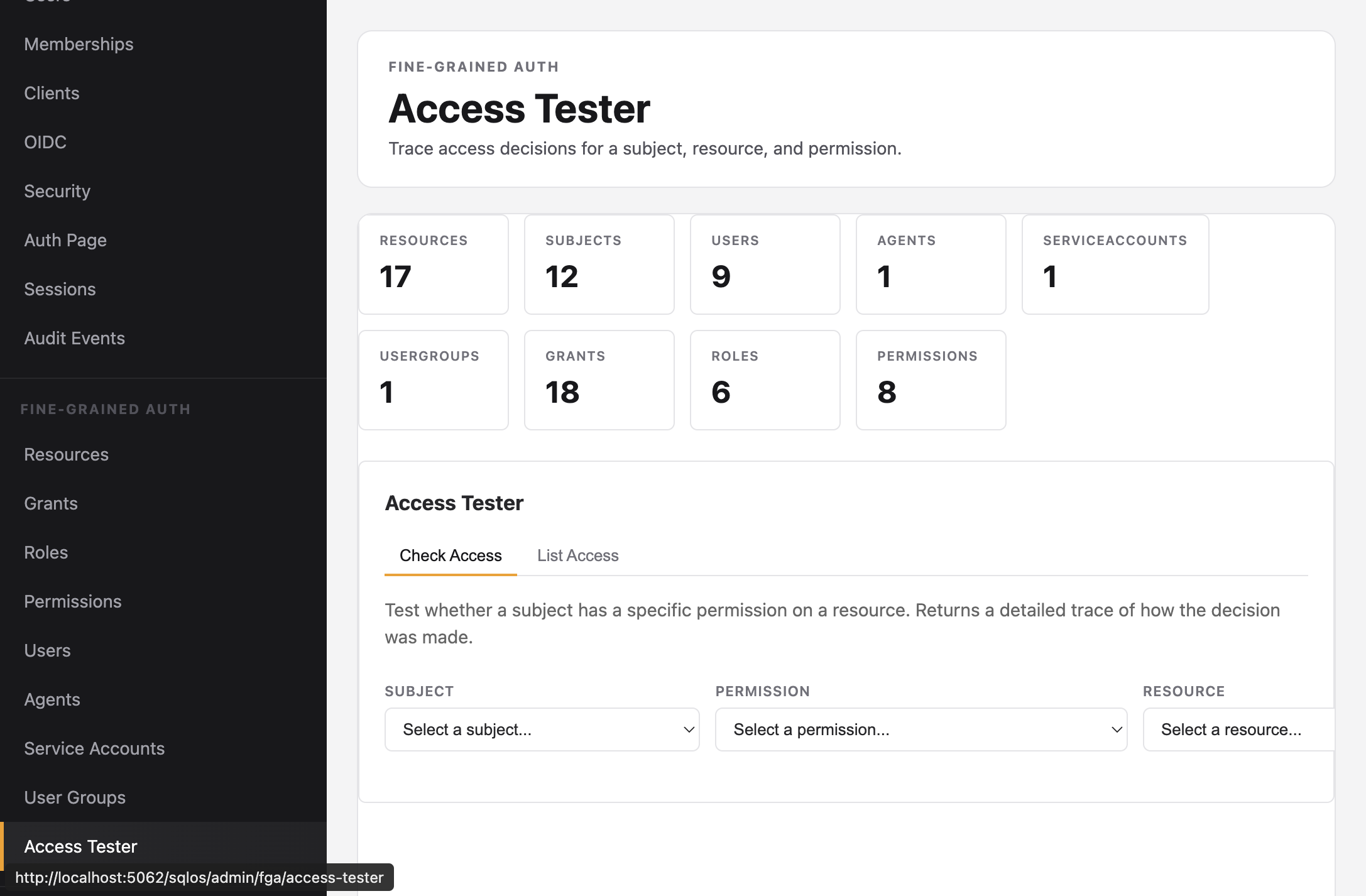
Select a subject, permission, and resource to see whether access is allowed and trace the decision path.
Create a protected entity after checking access to its parent resource. SqlOSDbContext<TContext> syncs the backing FGA resource row when the entity is saved.
using SqlOS.AuthServer.Extensions;
using SqlOS.Extensions;

var api = app.MapGroup("/api");

api.MapPost("/workspaces", async (
    CreateWorkspaceRequest request,
    AppDbContext db,
    ISqlOSFgaAuthService authService,
    HttpContext http,
    CancellationToken ct) =>
{
    var subjectId = http.GetSqlOSValidatedToken()?.UserId;
    if (string.IsNullOrWhiteSpace(subjectId))
        return Results.Unauthorized();

    var organizationResourceId = $"org::{request.OrganizationId}";

    var access = await authService.CheckAccessAsync(
        subjectId,
        "WORKSPACE_MANAGE",
        organizationResourceId);
    if (!access.Allowed)
        return Results.Json(new { error = "Permission denied" }, statusCode: 403);

    var workspaceId = Guid.NewGuid();
    var workspace = new Workspace
    {
        Id = workspaceId,
        ResourceId = $"workspace::{workspaceId:D}",
        OrganizationId = request.OrganizationId,
        Name = request.Name.Trim()
    };

    db.Workspaces.Add(workspace);
    await db.SaveChangesAsync(ct);

    return Results.Created($"/api/workspaces/{workspace.Id}", workspace);
});