Grants
Assign roles to subjects on resources.
A grant links a subject, a role, and a resource. The subject gains all permissions from the role on that resource and every descendant.
Create a grant
Dashboard: Fine-Grained Auth > Grants
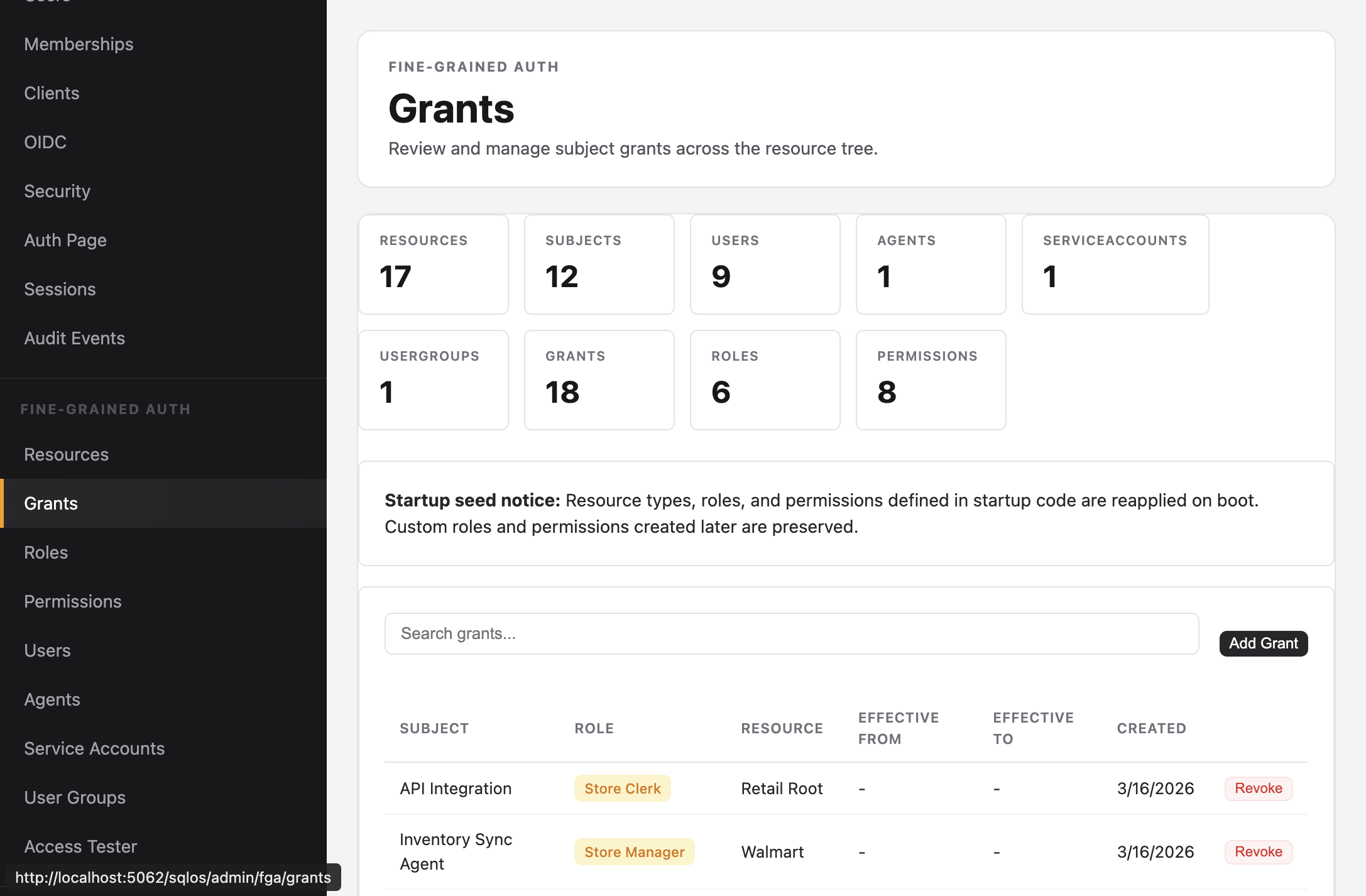
SDK:
context.Set<SqlOSFgaGrant>().Add(new SqlOSFgaGrant
{
    Id = SqlOSCryptoService.GenerateId("grant"),
    SubjectId = userId,
    ResourceId = "org::acme",
    RoleId = companyAdminRole.Id,
    Description = "Full access to Acme Corp"
});
await context.SaveChangesAsync(ct);
Admin API:
curl -X POST http://localhost:5062/sqlos/admin/fga/api/grants \
  -H "Content-Type: application/json" \
  -d '{
    "subjectId": "usr_...",
    "roleId": "role_...",
    "resourceId": "org::acme"
  }'
Inheritance
Grants inherit downward through the resource tree:
org::acme              ← grant: jane / Company Admin
  ├── walmart          ← jane inherits CHAIN_VIEW, CHAIN_EDIT
  │   ├── store-001    ← jane inherits LOCATION_VIEW, LOCATION_EDIT
  │   └── store-002    ← jane inherits LOCATION_VIEW, LOCATION_EDIT
  └── target           ← jane inherits CHAIN_VIEW, CHAIN_EDIT
Grant at a higher level = broader access. Grant at a lower level = narrower access.
A Store Clerk granted on store-001 can only see that one store's inventory. A Company Admin granted on org::acme sees everything underneath.
Revoke a grant
Admin API:
curl -X DELETE http://localhost:5062/sqlos/admin/fga/api/grants/{grantId}
Time-bounded grants
Grants support optional EffectiveFrom and EffectiveTo dates for temporary access:
new SqlOSFgaGrant
{
    SubjectId = contractorId,
    ResourceId = "store-001",
    RoleId = storeManagerRole.Id,
    EffectiveFrom = DateTime.UtcNow,
    EffectiveTo = DateTime.UtcNow.AddMonths(3)
}