Roles
Define roles as named sets of permissions.
A role is a named set of permissions. When you grant a role to a subject on a resource, the subject gains all of that role's permissions on that resource and its descendants.
builder.AddSqlOS<AppDbContext>(options =>
{
    options.Fga.Seed(seed =>
    {
        seed.Role("company_admin", "CompanyAdmin", "Company Admin");
        seed.Role("store_clerk", "StoreClerk", "Store Clerk");

        seed.RolePermission("CompanyAdmin", "CHAIN_VIEW");
        seed.RolePermission("CompanyAdmin", "CHAIN_EDIT");
        seed.RolePermission("CompanyAdmin", "LOCATION_VIEW");
        seed.RolePermission("CompanyAdmin", "LOCATION_EDIT");
        seed.RolePermission("CompanyAdmin", "INVENTORY_VIEW");
        seed.RolePermission("CompanyAdmin", "INVENTORY_EDIT");
        seed.RolePermission("StoreClerk", "INVENTORY_VIEW");
    });
});
Roles defined in startup are the authorization model. Change them in options.Fga.Seed and restart. The dashboard displays these built-in definitions read-only.
Path: Fine-Grained Auth > Roles
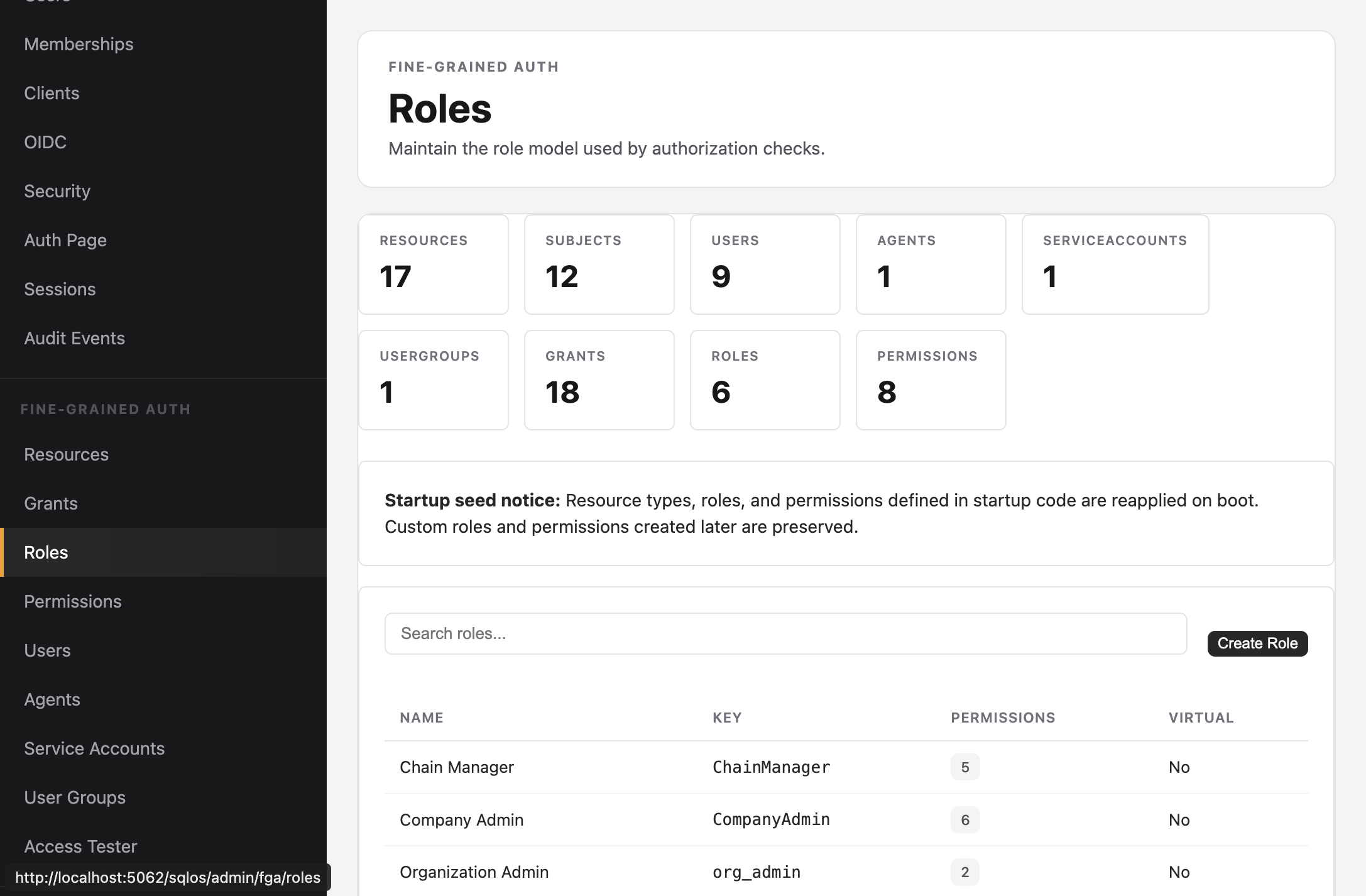
The Roles page lists all roles with their permission count so you can inspect the seeded model. Assign those roles to subjects on the Grants page.
public class SqlOSFgaRole
{
    public string Id { get; set; }
    public string Key { get; set; }         // e.g., "CompanyAdmin"
    public string DisplayName { get; set; } // e.g., "Company Admin"
    public string? Description { get; set; }
}| Role | Key | Permissions |
|---|---|---|
| Company Admin | CompanyAdmin | All chain, location, and inventory permissions |
| Chain Manager | ChainManager | CHAIN_VIEW, LOCATION_VIEW, LOCATION_EDIT, INVENTORY_VIEW, INVENTORY_EDIT |
| Store Manager | StoreManager | LOCATION_VIEW, INVENTORY_VIEW, INVENTORY_EDIT |
| Store Clerk | StoreClerk | INVENTORY_VIEW |
A customer role uses the same role, permission-link, and grant tables as a built-in role. Its
DefinitionSource is customer, its immutable OwnerResourceId identifies the owning resource,
and its generated ID is used in grants. Names are display text, not identifiers. Built-in roles
remain application definitions and cannot be changed through customer administration.
The application explicitly enables available permissions after declaring them:
options.Fga.Seed(seed =>
{
    seed.Permission("CHECKLIST_ASSIGN", "Assign work", "checklist");
    seed.Permission("CHECKLIST_FINISH", "Finish a checklist", "checklist");
    seed.AllowInCustomRoles("CHECKLIST_ASSIGN", "CHECKLIST_FINISH");
});
Configure Fga.CustomRoles.ManagePermission, OwnerResourceTypes, and
IsEligibleRecipientAsync before enabling administration. The management permission must not
be selectable in customer roles. The recipient policy must validate current organization
membership (including squads); do not compare resource ID prefixes or assume a user belongs to
only one organization. With missing policy, administration fails closed.
Use SqlOSCustomRoleService with a principal obtained from authenticated server context:
var role = await roles.CreateAsync(callerPrincipalId, organizationResourceId,
    new SqlOSCustomRoleWrite("Cleaning supervisor", null,
        ["CHECKLIST_ASSIGN", "CHECKLIST_FINISH"]), cancellationToken);
await roles.GrantAsync(callerPrincipalId, organizationResourceId,
    role.Id, role.Revision, supervisorsSubjectId, organizationResourceId, cancellationToken);
A grant may target the owner or its descendants, never another organization's tree. Do not use
the ordinary GrantRoleAsync helper for a customer role: the administration service also checks
recipient eligibility, serializes changes and records audit history.
ListAsync returns a bounded, owner-scoped cursor page of definitions. ListGrantsAsync returns a bounded page of the selected role's grants, after checking the caller and owner; use it to show who an edit will affect.
UpdateAsync replaces the permission set and requires the last observed revision. Changes
apply to all existing holders. Grants and revocations also advance the revision. A stale request
returns stale_revision; reload rather than blindly replaying it. RetireAsync removes the role's
grants, archives the definition and preserves audit history. Built-in ownership and assignment
grants are unaffected by these operations.
Point checks, access traces and authorized-list functions reject archived customer roles, unapproved permissions and grants outside the owner's subtree. Moving a granted resource outside that subtree makes that custom grant ineffective; an ordinary grant does not acquire authority in the new organization. Unsupported direct table writes are not a management API.
The service commits its own transaction when called alone. Inside an existing transaction it uses a savepoint; the caller then owns the final commit. Role changes and their SqlOS audit records commit or roll back together. Save staged changes before calling it, and discard tracked state after a failed operation.
Use WithOwnerTransactionAsync for membership changes or offboarding that alter who can hold a
role. In that callback, change the host's membership and revoke its custom-role grants using the
same scoped DbContext and service. Save staged membership changes before nested role operations.
The shared owner lock prevents concurrent grants from passing an eligibility check during that
change, and a failure rolls back membership, role grants and their audit records together.
Its public actor-based API is suitable for application adapters. The authenticated operator
dashboard uses the same service through POST /sqlos/admin/fga/api/custom-roles; it records an
operator actor and still enforces owner, recipient, permission, revision and lifecycle rules.
The JSON action is create, update, grant, revoke or retire, with ownerResourceId,
id, revision, and the corresponding definition or grant fields. Operator endpoints are not
customer endpoints and must never be exposed as an organization administration shortcut.
The Roles dashboard distinguishes application and customer definitions. Customer role details provide editing, granting and retirement; application definitions stay read-only. Existing startup seeds never overwrite a customer's definition. Customer definitions are not seeded: applications seed the permission vocabulary and manage runtime customer choices through the service.
When an organization removes a member, its application must revoke direct custom-role grants as part of offboarding. Recipient eligibility is checked when granting; it is not a dynamic membership predicate in every SQL read. Removing someone from a squad immediately removes access inherited through that squad, while other independent grants still apply.
Upgrade every process that evaluates FGA or initializes its database functions before creating customer roles. Older versions do not enforce customer ownership or permission eligibility and can replace the SQL functions on startup. Keep customer administration disabled until that upgrade is complete; do not roll back to an older FGA runtime while serving customer-role grants. The schema additions preserve existing built-in roles and grants as application-owned definitions.
The owning resource is retained while definitions refer to it. Deactivate that resource to close its subtree; do not hard-delete an organization resource while retaining its role definitions. A host must also authorize squad membership changes: anyone allowed to add a member to a squad can give that person every role held by the squad. The grant recipient policy does not replace that membership policy.
A host that reconciles membership and grants inside SaveChanges already has staged membership changes. Begin or join the host transaction and call SqlOSCustomRoleService.LockOwnerAsync(db, ownerResourceId) before reading grants to remove. This is a trusted lifecycle coordination API: it does not authorize membership changes, save rows, or replace the host's membership audit. Lock multiple owners in ordinal order and retain the transaction through the final save/commit. Relational calls without a transaction fail; in-memory fixtures provide no concurrency guarantee.
For offboarding, reconcile the recipient's customer grants by the role's OwnerResourceId as well as the application's normal node relationships, so a previously moved grant cannot be revived later. The membership change and removal of those grants must commit together. Role administration remains through the management service; this hook lets the host's existing membership reconciliation share its lock without pretending a staged membership change is an interactive role edit.